

Building a home is one of the most exciting, emotionally rewarding, and financially significant milestones in your life. You’ve likely spent countless hours picking out the perfect floor plan, envisioning the interior design, and dreaming about the memories you’ll create. But before you can start picking out paint colors and light fixtures, you have to make a crucial decision that will literally hold your house together: choosing the right cement.
If you’ve spoken to contractors or visited a hardware supplier, you’ve probably been hit with an alphabet soup of cement types—namely, PSC and PPC.
It’s easy to feel overwhelmed when faced with technical construction jargon. You just want a home that is safe, durable, and built to last for generations. So, what exactly do these acronyms mean, and more importantly, which one is the right choice for your dream home?
In this comprehensive guide by Artscape Developers, we are breaking down everything you need to know about Portland Slag Cement (PSC) and Portland Pozzolana Cement (PPC). We’ll explore their unique properties, compare their strengths and weaknesses, and help you make a confident, informed decision for your residential construction project.
Let’s pour a solid foundation of knowledge!
What is Portland Slag Cement (PSC)?
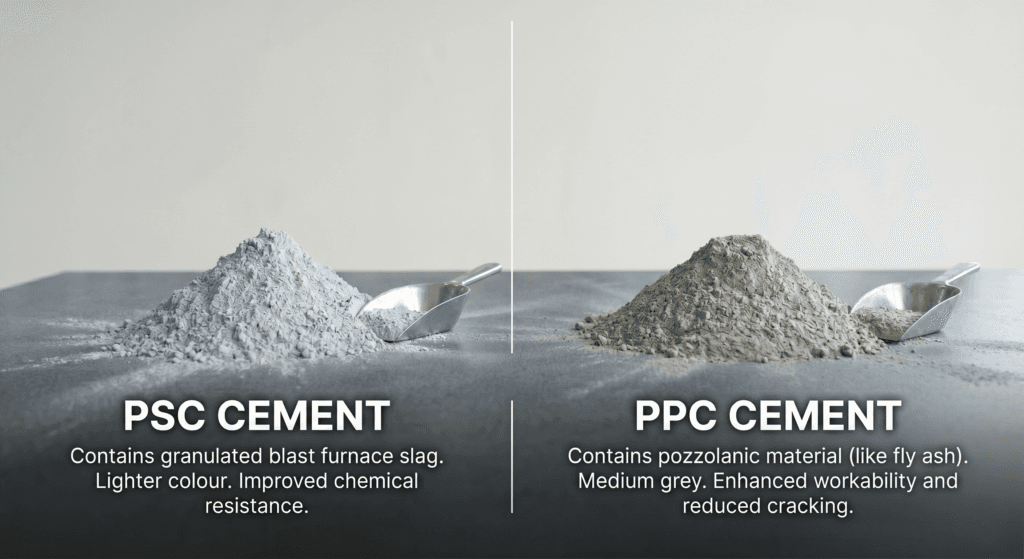
Portland Slag Cement, commonly known as PSC, is a type of blended cement. It is manufactured by combining standard Portland cement clinker with gypsum and granulated blast furnace slag (often referred to as GGBS).
Slag is a non-metallic by-product of the iron and steel manufacturing process. Instead of letting this material go to waste, the construction industry repurposes it. By grinding it down and blending it with traditional cement, manufacturers create a highly durable and incredibly resilient building material. According to Indian Standard IS 455, PSC is an incredibly versatile hydraulic cement that has become a staple in modern construction.
The Key Benefits of PSC Cement
- Exceptional Durability in Harsh Conditions: Because of its unique chemical composition, PSC offers phenomenal resistance to harsh chemicals like sulphates and chlorides. This makes it the undisputed champion for construction in coastal areas, or in soils where ground-water chemical exposure is high.
- Reduced Heat of Hydration: When water mixes with cement, a chemical reaction occurs that produces heat. If too much heat is produced too quickly, the concrete can develop microscopic cracks (thermal cracking). PSC has a significantly lower heat of hydration than ordinary cement, drastically reducing the risk of shrinkage and cracking.
- Eco-Friendly Champion: Because PSC utilizes industrial slag—displacing a large percentage of the limestone clinker usually required—it has a much lower carbon footprint. It is widely considered a Green Cement, perfect for environmentally conscious homeowners.
- Ultimate Long-Term Strength: While it might not set as fast as standard cement, PSC continues to gain strength over an extended period. Years down the line, a foundation poured with PSC will be incredibly dense and impermeable.
What is Portland Pozzolana Cement (PPC)?
On the other side of the ring, we have Portland Pozzolana Cement (PPC). Like PSC, PPC is a blended cement. However, instead of using steel slag, PPC is created by inter-grinding Portland cement clinker with gypsum and pozzolanic materials—most commonly fly ash, which is a by-product of coal-fired thermal power plants.
The addition of fly ash changes the physical and chemical properties of the cement, making it exceptionally workable and smooth. It has become one of the most widely used cements in general residential construction around the world.
The Key Benefits of PPC Cement
- Superior Workability: The spherical nature of fly ash particles acts almost like tiny ball bearings within the wet concrete mix. This makes PPC highly workable, easy to mix, and smooth to apply.
- Excellent Surface Finish: Because it is so workable and fine, PPC yields a beautifully smooth finish. This makes it the absolute go-to choice for plastering, masonry work, and detailed architectural elements.
- Water-Tight Density: The pozzolanic reaction in PPC happens slowly over time, filling in the microscopic pores within the concrete. This creates a highly dense, impermeable structure that resists water seepage—a critical feature for roofs and basements.
- Cost-Effective: Because fly ash is widely available and affordable, PPC is often slightly more budget-friendly without compromising on quality or long-term strength.
PSC vs. PPC Cement: Key Differences You Need to Know
Now that we understand what each type of cement is, let’s pit them against each other in the categories that matter most to your home construction.
1. Initial Setting Time and Strength Gain
- PPC: Takes a bit longer to set initially compared to Ordinary Portland Cement (OPC), but it catches up in strength after 28 days.
- PSC: Also has a slower initial setting time, but its ultimate strength (strength evaluated after 90 days and beyond) is often higher than both OPC and PPC. If you have the patience for a slightly longer curing period, PSC rewards you with unmatched long-term load-bearing capacity.
(Want to learn more about the timelines of home building? Check out our Step-by-Step Guide to the Home Construction)
2. Resistance to Elements
- PPC: Excellent at preventing water permeability and dampness. It provides moderate resistance to chemical attacks.
- PSC: The undisputed winner when it comes to resisting aggressive environments. If your home is near the sea, or if your local soil is high in salts and sulphates, PSC will protect your foundation’s steel reinforcement bars (rebar) from corrosion far better than PPC.
3. Workability and Finish
- PPC: Because of the fine fly ash, PPC mixes effortlessly and spreads beautifully. It is ideal for the aesthetic parts of your home where surface finish matters.
- PSC: While very workable, it is slightly coarser than PPC. It is better suited for structural, heavy-duty applications where strength takes precedence over a silky-smooth surface texture.
4. Heat of Hydration
- PPC: Produces low heat, reducing shrinkage cracks.
- PSC: Produces even lower heat than PPC. For massive concrete pours—like thick foundation rafts or retaining walls—PSC is generally preferred to keep the core temperature of the concrete stable.
The Pros and Cons of Using PSC Cement
To make things easy, here is a quick summary of what to expect if you choose PSC.
Pros:
- Offers the highest long-term compressive strength.
- Unrivaled defense against chloride and sulphate attacks (prevents steel rusting).
- Greatly reduces the risk of thermal cracking in large structures.
- Highly sustainable and environmentally friendly.
Cons:
- Slower initial setting time means construction formwork (the molds holding the wet concrete) must be kept in place a bit longer.
- Might not offer the absolute smoothest finish for delicate plastering compared to PPC.
The Pros and Cons of Using PPC Cement
If you are leaning toward PPC, here is your quick summary.
Pros:
- Provides a stunning, crack-free finish for walls and facades.
- Highly impermeable, making it excellent for waterproofing roofs and water tanks.
- Very cost-effective and widely available.
- Easier for masons to handle and apply due to superior workability.
Cons:
- Like PSC, it has a slower initial setting time than traditional OPC.
- While resistant to chemicals, it is not as robust as PSC in highly aggressive, salt-heavy environments.
Which Cement is Best for Your Home Construction?
The truth is, asking which cement is better is the wrong question. The real question is: Where in your home should you use them? A well-built home often utilizes a strategic combination of different materials based on structural needs.
Here is our expert recommendation for how to allocate these cements in your home build:
When to Choose PSC (The Heavy Lifter)
You should use Portland Slag Cement for the core structural components of your home. Because of its incredible ultimate strength, crack resistance, and anti-corrosive properties, PSC is the ideal choice for:
- Foundations and Footings: The roots of your home need to resist soil chemicals and moisture.
- Columns and Beams: The skeleton of your home requires high load-bearing capacity.
- Basements and Retaining Walls: Where soil pressure and moisture are constant threats.
- Homes in Coastal Regions: If you live near the ocean, PSC is non-negotiable to prevent salt-air corrosion of your steel reinforcements.
When to Choose PPC (The Finisher)
You should use Portland Pozzolana Cement for non-load-bearing elements, masonry, and finishing works where workability and water-tightness are the top priorities. PPC is the ideal choice for:
- Brickwork and Block Masonry: The mortar holding your bricks together will benefit from PPC’s high adhesion and smooth consistency.
- Plastering (Internal and External): PPC yields a beautiful, smooth finish that requires less effort to paint over and resists surface cracking.
- Roof Slabs: Because of its high impermeability, PPC helps prevent water leakage from your roof.
- Tiling and Flooring: Provides an excellent, workable base for setting tiles securely.
(Curious about the materials we use in our luxury builds? Browse our Project Portfolio to see quality in action.)
Why Choose Artscape Developers for Your Construction Needs?
Understanding the nuances of construction materials is just the tip of the iceberg when it comes to building a custom home. You shouldn’t have to spend your evenings agonizing over chemical compositions and concrete curing times. That’s what we are here for.
At Artscape Developers, we believe that a truly beautiful home is built on a foundation of uncompromised quality, transparency, and expert engineering. We don’t just build houses; we craft personalized living spaces designed to stand the test of time.
When you partner with us, you gain a team of seasoned architects, structural engineers, and master builders who know exactly when to deploy materials like PSC and PPC to maximize the safety, durability, and aesthetic perfection of your home. We handle the heavy lifting, the technical details, and the rigorous quality checks so you can focus on the exciting parts—like designing your dream kitchen or planning your backyard oasis.
(Ready to start planning your dream space? Explore our Comprehensive Guide to Dream Home Design with Artscape.)
Conclusion: Build Your Future on a Solid Foundation
Choosing between PSC and PPC cement doesn’t have to be a headache. Remember the golden rule: Use PSC for the structural bones and heavy lifting (foundations, columns, slabs), and use PPC for the skin and finishing touches (masonry, plastering, waterproofing). By utilizing the unique strengths of both materials, you ensure that your home is not only structurally invincible but also beautifully finished.
Building a house is a monumental task, but you don’t have to do it alone. If you want the peace of mind that comes from knowing every single brick, beam, and bag of cement is being utilized perfectly, you need an expert by your side.
Are you ready to turn your dream home into a reality? Don’t leave your construction to chance.
Call Artscape Developers today to schedule your free consultation, and let’s start building a masterpiece that will last a lifetime!