


Construction Materials

Cement Blocks: Types, Uses, and Cost-Saving Benefits

Cement Blocks: Types, Uses & Cost-Saving Benefits

Introduction: The Changing Face of Modern Construction Building a home or commercial property is a monumental milestone. It is an intricate journey of transforming an architectural vision into a structural reality that feels safe, looks exceptional, and stands resilient for generations. However, developers and individual builders often find themselves caught in a challenging balancing act: how do you achieve uncompromising structural integrity while keeping skyrocketing material and labor costs under control? In highly dynamic urban landscapes, environmental demands, logistical hurdles, and tight budgetary constraints constantly test the feasibility of construction projects. Traditional clay bricks, while historically reliable, frequently fall short when it comes to speed of execution, thermal efficiency, and cost-effectiveness. Enter the modern game-changer: cement blocks. Far from being mere pieces of compressed concrete, advanced cement blocks are reshaping the structural landscape of modern architecture. From towering commercial hubs to sustainable family homes, these engineering marvels offer an optimized blend of durability, design flexibility, and fiscal relief. Whether you are partnering with the Best construction companies in Bangalore or managing your own structural layout, understanding the distinct profiles, applications, and financial advantages of cement blocks is the key to unlocking a future-proof asset. In this exhaustive guide, we will break down the primary types of cement blocks, explore their versatile engineering applications, and analyze how making the switch can save you up to 15% on your total construction budget. 1. What Are Cement Blocks? (An Overview) At its core, a cement block—often referred to as a concrete masonry unit (CMU)—is a precast structural component manufactured from a precise mixture of Portland cement, graded sand, gravel, and water. Unlike traditional clay bricks that depend on extensive topsoil excavation and energy-intensive kiln baking, cement blocks are molded and cured under meticulously controlled industrial conditions. This standardized manufacturing process yields exceptional uniformity in size, shape, and density. To further elevate the environmental and structural profile of these units, top-tier manufacturers frequently incorporate industrial by-products like fly ash. This specialized addition alters the micro-structural matrix of the block, minimizing porosity while substantially reducing the carbon footprint of production. From a global perspective, the shift toward concrete masonry is massive. The global concrete block and brick manufacturing market size is projected to scale from USD 955.5 Billion to a staggering USD 1,529.0 Billion, expanding at a steady CAGR of 4.8%. This macro-economic transition underscores a fundamental reality: modern infrastructure demands materials that are structurally superior, highly scalable, and structurally optimized for rapid assembly. 2. Solid vs. Hollow vs. Cellular: Understanding the Core Types Not all construction zones share the same load profiles or environmental stresses. To maximize performance, engineers segment cement blocks into three primary structural classifications: Solid Blocks, Hollow Blocks, and Cellular Blocks. Selecting the correct typology is vital for balance, weight distribution, and functional efficiency. +—————————————————————–+ | CEMENT BLOCK TYPES | +————————–+————————————–+ | 1. SOLID BLOCKS | High density, heavy load-bearing | +————————–+————————————–+ | 2. HOLLOW BLOCKS | Dual voids, lightweight, insulating | +————————–+————————————–+ | 3. CELLULAR BLOCKS | Air-entrained, ultra-light, acoustic | +————————–+————————————–+ Solid Blocks Solid cement blocks are high-density, heavyweight units engineered to withstand immense compressive forces. They contain minimal to no voids, ensuring that the entire volume of the block contributes directly to its load-bearing capacity. Engineering Profiles: Typically feature a high characteristic compressive resistance, making them ideal for heavy load distribution. Primary Structural Uses: Load-bearing external walls, foundational footings, retaining structures, basements, and high-security perimeter walls. Key Advantage: Exceptional structural mass providing unmatched resistance to physical impact, seismic forces, and lateral earth pressures. Hollow Blocks Hollow cement blocks feature one or more engineered inner cores or voids that reduce the overall weight of the block without compromising its structural perimeter. The total volume of the cores generally ranges from 25% to 50% of the gross cross-sectional area. Engineering Profiles: Designed with thick shell walls and interior webs that maintain excellent vertical load pathways while creating stagnant air chambers. Primary Structural Uses: Multi-story frame infill walls, internal partition walls, non-load-bearing facades, and boundary structures. Key Advantage: Significant dead-weight reduction for the building frame, coupled with natural thermal and acoustic insulation barriers provided by the hollow chambers. Cellular Blocks Cellular blocks (often overlapping with light-weight aerated blocks) are produced by trapping microscopic, non-connected air bubbles throughout the concrete mixture, or by creating deeply recessed single-ended cavities within the block. Engineering Profiles: Low-density blocks characterized by a highly porous internal structure that dramatically minimizes mass while retaining a stable external face. Primary Structural Uses: Lightweight internal partitioning, high-rise architectural adjustments where dead load must be minimized, and spaces requiring strict acoustic isolation. Key Advantage: Unparalleled ease of cutting, drilling, and shaping on-site, alongside superb thermal resistance properties. 3. Key Structural and Architectural Uses The absolute uniformity and structural versatility of concrete blocks make them an architectural favorite across residential, commercial, and industrial ecosystems. When executing blueprints with top construction companies in bangalore, you will find concrete masonry integrated into several key structural areas: Load-Bearing External Masonry For low-to-medium rise structures, solid cement blocks completely eliminate the need for costly reinforced concrete columns and beams. The blocks themselves absorb and safely transfer the dead loads of roofs and upper floors directly down to the foundations, significantly optimizing material workflows. High-Rise Non-Structural Infill In RCC (Reinforced Concrete Frame) skyscrapers, hollow and cellular blocks serve as the perfect infill material. Because the structural load is entirely handled by a concrete skeleton, these lighter blocks fill the exterior voids, preventing structural overload on lower levels while creating a smooth facade for exterior rendering. Subterranean Foundations and Retaining Walls Due to their superior resistance to groundwater penetration and lateral earth pressures, solid cement blocks are highly preferred for building robust basement walls, drainage culverts, step-foundations, and landscaping retaining systems. Thermal and Acoustic Enclosures Spaces that demand quiet environments or precise climate control—such as auditoriums, commercial workspaces, schools, and modern family residential complexes—leverage the natural air-pockets inside hollow concrete walls to block ambient street noise and stabilize interior temperatures. 4. Cost-Saving Benefits: How Cement Blocks Protect

Cement Blocks: Types, Uses & Cost-Saving Benefits Read More »
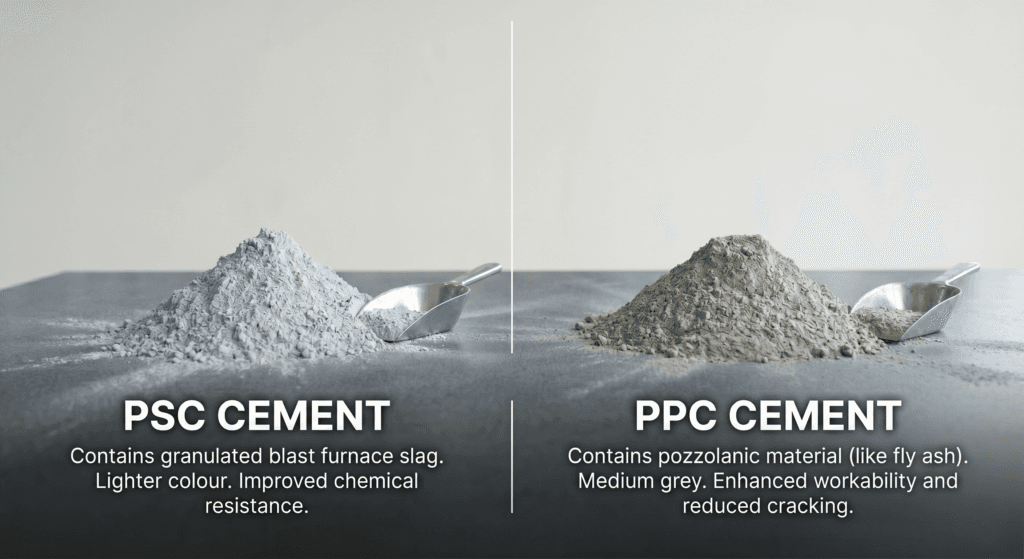
PSC Cement vs PPC Cement

PSC vs. PPC Cement – Which is Best for Your Home Construction?

Building a home is one of the most exciting, emotionally rewarding, and financially significant milestones in your life. You’ve likely spent countless hours picking out the perfect floor plan, envisioning the interior design, and dreaming about the memories you’ll create. But before you can start picking out paint colors and light fixtures, you have to make a crucial decision that will literally hold your house together: choosing the right cement. If you’ve spoken to contractors or visited a hardware supplier, you’ve probably been hit with an alphabet soup of cement types—namely, PSC and PPC. It’s easy to feel overwhelmed when faced with technical construction jargon. You just want a home that is safe, durable, and built to last for generations. So, what exactly do these acronyms mean, and more importantly, which one is the right choice for your dream home? In this comprehensive guide by Artscape Developers, we are breaking down everything you need to know about Portland Slag Cement (PSC) and Portland Pozzolana Cement (PPC). We’ll explore their unique properties, compare their strengths and weaknesses, and help you make a confident, informed decision for your residential construction project. Let’s pour a solid foundation of knowledge! What is Portland Slag Cement (PSC)? Portland Slag Cement, commonly known as PSC, is a type of blended cement. It is manufactured by combining standard Portland cement clinker with gypsum and granulated blast furnace slag (often referred to as GGBS). Slag is a non-metallic by-product of the iron and steel manufacturing process. Instead of letting this material go to waste, the construction industry repurposes it. By grinding it down and blending it with traditional cement, manufacturers create a highly durable and incredibly resilient building material. According to Indian Standard IS 455, PSC is an incredibly versatile hydraulic cement that has become a staple in modern construction. The Key Benefits of PSC Cement Exceptional Durability in Harsh Conditions: Because of its unique chemical composition, PSC offers phenomenal resistance to harsh chemicals like sulphates and chlorides. This makes it the undisputed champion for construction in coastal areas, or in soils where ground-water chemical exposure is high. Reduced Heat of Hydration: When water mixes with cement, a chemical reaction occurs that produces heat. If too much heat is produced too quickly, the concrete can develop microscopic cracks (thermal cracking). PSC has a significantly lower heat of hydration than ordinary cement, drastically reducing the risk of shrinkage and cracking. Eco-Friendly Champion: Because PSC utilizes industrial slag—displacing a large percentage of the limestone clinker usually required—it has a much lower carbon footprint. It is widely considered a Green Cement, perfect for environmentally conscious homeowners. Ultimate Long-Term Strength: While it might not set as fast as standard cement, PSC continues to gain strength over an extended period. Years down the line, a foundation poured with PSC will be incredibly dense and impermeable. What is Portland Pozzolana Cement (PPC)? On the other side of the ring, we have Portland Pozzolana Cement (PPC). Like PSC, PPC is a blended cement. However, instead of using steel slag, PPC is created by inter-grinding Portland cement clinker with gypsum and pozzolanic materials—most commonly fly ash, which is a by-product of coal-fired thermal power plants. The addition of fly ash changes the physical and chemical properties of the cement, making it exceptionally workable and smooth. It has become one of the most widely used cements in general residential construction around the world. The Key Benefits of PPC Cement Superior Workability: The spherical nature of fly ash particles acts almost like tiny ball bearings within the wet concrete mix. This makes PPC highly workable, easy to mix, and smooth to apply. Excellent Surface Finish: Because it is so workable and fine, PPC yields a beautifully smooth finish. This makes it the absolute go-to choice for plastering, masonry work, and detailed architectural elements. Water-Tight Density: The pozzolanic reaction in PPC happens slowly over time, filling in the microscopic pores within the concrete. This creates a highly dense, impermeable structure that resists water seepage—a critical feature for roofs and basements. Cost-Effective: Because fly ash is widely available and affordable, PPC is often slightly more budget-friendly without compromising on quality or long-term strength. PSC vs. PPC Cement: Key Differences You Need to Know Now that we understand what each type of cement is, let’s pit them against each other in the categories that matter most to your home construction. 1. Initial Setting Time and Strength Gain PPC: Takes a bit longer to set initially compared to Ordinary Portland Cement (OPC), but it catches up in strength after 28 days. PSC: Also has a slower initial setting time, but its ultimate strength (strength evaluated after 90 days and beyond) is often higher than both OPC and PPC. If you have the patience for a slightly longer curing period, PSC rewards you with unmatched long-term load-bearing capacity. (Want to learn more about the timelines of home building? Check out our Step-by-Step Guide to the Home Construction)  2. Resistance to Elements PPC: Excellent at preventing water permeability and dampness. It provides moderate resistance to chemical attacks. PSC: The undisputed winner when it comes to resisting aggressive environments. If your home is near the sea, or if your local soil is high in salts and sulphates, PSC will protect your foundation’s steel reinforcement bars (rebar) from corrosion far better than PPC. 3. Workability and Finish PPC: Because of the fine fly ash, PPC mixes effortlessly and spreads beautifully. It is ideal for the aesthetic parts of your home where surface finish matters. PSC: While very workable, it is slightly coarser than PPC. It is better suited for structural, heavy-duty applications where strength takes precedence over a silky-smooth surface texture. 4. Heat of Hydration PPC: Produces low heat, reducing shrinkage cracks. PSC: Produces even lower heat than PPC. For massive concrete pours—like thick foundation rafts or retaining walls—PSC is generally preferred to keep the core temperature of the concrete stable. The Pros and Cons of Using PSC Cement To make things easy, here is

PSC vs. PPC Cement – Which is Best for Your Home Construction? Read More »

Steel Testing in Lab

The Ultimate Guide to Steel Testing Methods: Types, Standards, and Why They Matter

When you look at a towering skyscraper, a sprawling commercial complex, or even a modern residential home, what do you see? Most people notice the sleek glass facades, the modern architectural designs, or the beautiful landscaping. But as developers and builders, we know the real magic lies beneath the surface. It’s the steel skeleton that holds everything together, providing the strength and resilience needed to withstand the test of time, extreme weather, and everyday wear and tear. But here is the million-dollar question: How do you know that the steel holding up your building is actually up to the job? You can’t just look at a steel beam and guess its load-bearing capacity or spot microscopic internal flaws. That is where steel testing methods come into play. Whether you are breaking ground on a massive industrial facility or framing a custom home, verifying the quality of your materials isn’t just a best practice—it is an absolute necessity. In this ultimate guide, we are going to dive deep into the world of steel testing. We will explore the different types of testing methods, break down the critical industry standards, and explain exactly why all of this matters for your next project with Artscape Developers. What is Steel Testing and Why is it Essential? At its core, steel testing is a rigorous set of scientific processes designed to evaluate the mechanical, physical, and chemical properties of steel materials. Think of it as a comprehensive health check-up for your construction materials. Before a single beam is welded or bolted into place, it needs to prove it can handle the stress. Why is this so critical? First and foremost, safety. A compromised steel structure can lead to catastrophic failures. Microscopic cracks, internal voids, or improper chemical compositions can drastically weaken a beam. During an earthquake, high winds, or simply under the heavy static load of the building itself, those weaknesses can give way. Secondly, there is the issue of financial liability and longevity. Fixing structural defects after a building is erected is a logistical nightmare and a massive financial drain. It can lead to delayed project timelines, lawsuits, and skyrocketing insurance premiums. In fact, many insurance providers offer better rates for buildings constructed with certified, rigorously tested steel frames because they are proven to resist fire, warping, and seismic activity. By investing in proper steel testing, you are guaranteeing peace of mind. You are ensuring that the materials meet exact engineering specifications and that your investment will stand tall for decades. Destructive Testing (DT) vs. Non-Destructive Testing (NDT) When we talk about steel testing, the methods generally fall into two main categories: Destructive Testing (DT) and Non-Destructive Testing (NDT). Understanding the difference between the two is the first step in creating a solid quality assurance plan. Destructive Testing (DT) Just as the name implies, Destructive Testing involves taking a sample of the steel and pushing it to its absolute breaking point. The goal is to physically deform, break, or destroy the material to understand its limits. Because the sample is destroyed, DT is typically performed on a representative batch of materials at a laboratory rather than on the actual beams that will be used in the final structure. Non-Destructive Testing (NDT) Non-Destructive Testing, on the other hand, allows inspectors to evaluate the properties of a material, component, or system without causing any damage. It’s like taking an X-ray or an ultrasound of the steel. NDT is incredibly valuable because it can be performed on the actual materials being used on the construction site, and it can even be used to inspect existing structures to monitor their health over time. Both methods are essential. DT tells you the ultimate limits of the batch, while NDT ensures that the specific pieces being installed are free from hidden defects. Common Types of Destructive Steel Testing Methods To truly understand how much stress a piece of steel can take, engineers subject samples to a series of brutal physical tests. Here are the most common types of destructive tests used in the industry: 1. Tensile Testing Tensile testing is the most fundamental of all steel tests. A sample of the steel is clamped into a machine and pulled apart from opposite ends until it eventually snaps. This test measures the steel’s “yield strength” (the point at which it begins to permanently deform) and its “ultimate tensile strength” (the maximum stress it can handle before breaking). This data is crucial for structural engineers who need to calculate exactly how much weight the building’s framework can support. 2. Charpy V-Notch Impact Testing Steel behaves differently depending on the temperature. A beam that is incredibly tough in the summer might become brittle and prone to shattering in freezing winter temperatures. The Charpy Impact Test involves machining a small V-shaped notch into a steel sample and then striking it with a heavy swinging pendulum. By measuring how much energy the steel absorbs before breaking, engineers can determine its toughness and its susceptibility to brittle fracture at various temperatures. 3. Hardness Testing Hardness testing measures a material’s resistance to permanent indentation or scratching. In tests like the Brinell or Rockwell hardness tests, a hardened steel ball or diamond cone is pressed into the surface of the steel under a specific load. The size or depth of the resulting indentation is then measured. Hardness is often a great indicator of other mechanical properties, such as tensile strength and wear resistance. 4. Bending and Compression Tests The bend test evaluates the ductility of the steel—how well it can be bent without cracking on the outside of the curve. This is particularly important for reinforced concrete structures where rebar must be bent into complex shapes. Compression testing is the opposite of tensile testing; it involves crushing the sample to see how much load it can bear before failing, which is vital for columns and foundational supports. Essential Non-Destructive Testing (NDT) Methods Because we can’t break every piece of steel we intend to use, Non-Destructive Testing is

The Ultimate Guide to Steel Testing Methods: Types, Standards, and Why They Matter Read More »