

Bangalore’s residential skyline is evolving, and homeowners are increasingly seeking greener ways to build their dream homes. This eco-friendly construction materials Bangalore guide explores the latest sustainable options that blend durability with low environmental impact, helping you make informed choices for a healthier living space. From reclaimed brick and fly‑ash concrete to bamboo flooring and recycled steel, each material is evaluated for its suitability in the city’s climate, cost‑effectiveness, and compliance with local building codes. By embracing these alternatives, you not only reduce your carbon footprint but also create a resilient structure that stands the test of time.
In Bangalore’s hot, monsoon‑prone environment, material selection is critical. Hempcrete walls provide excellent insulation, keeping interiors cool during scorching summers while absorbing moisture in rainy months. Low‑VOC paints and natural lime plaster improve indoor air quality, essential for families with children or seniors. For foundations, stabilized laterite offers a locally sourced alternative to traditional cement, cutting transportation emissions. Many suppliers now offer modular green panels that integrate solar shading and rainwater harvesting, turning the house into an energy‑efficient system. By prioritizing these eco‑friendly construction materials, Bangalore homeowners can achieve modern aesthetics, long‑term savings, and a genuine commitment to sustainability in today’s market for the future.
Understanding Eco‑Friendly Materials: Definitions & Benefits
In Bangalore’s rapidly expanding residential market, builders are turning to sustainable building materials that minimise ecological footprints while delivering durability and comfort. Eco‑friendly construction materials are those that are sourced, manufactured, and disposed of in ways that conserve resources, lower emissions, and enhance the health of occupants.
What qualifies as eco‑friendly in construction
Materials earn the eco‑friendly label when they meet at least one of several sustainability criteria recognised by Indian green‑building standards such as GRIHA and LEED India.
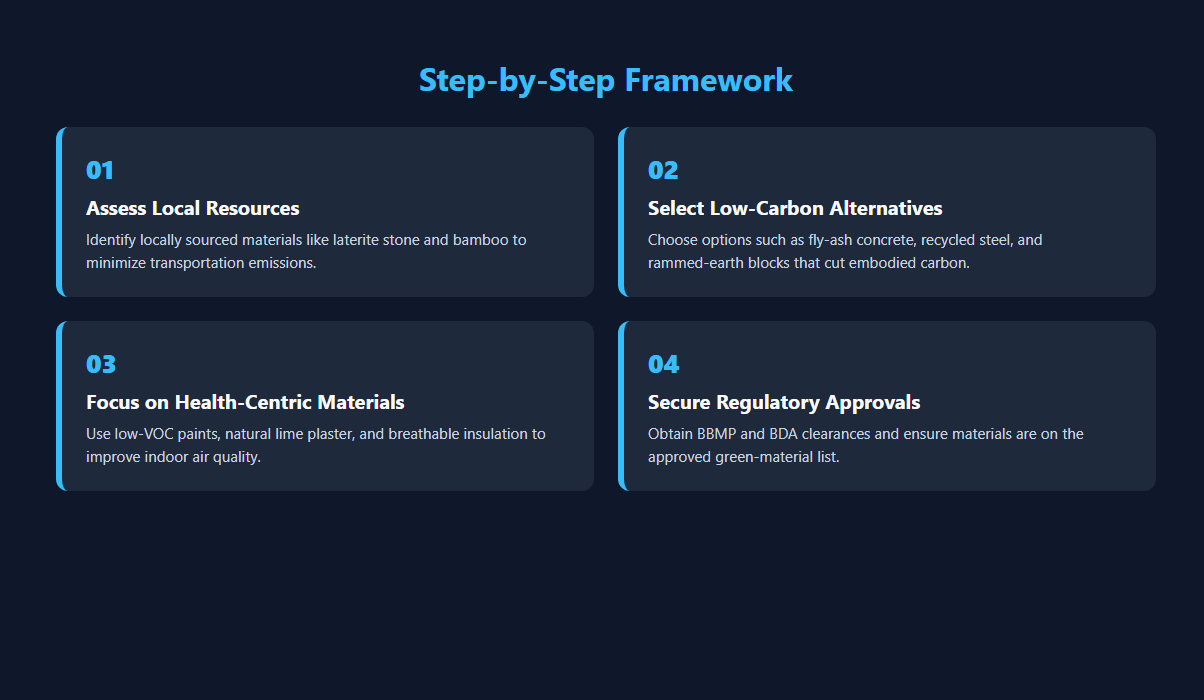
- Locally sourced raw inputs that reduce transportation energy, e.g., laterite stone from Karnataka.
- Renewable or recycled content, such as bamboo flooring, fly‑ash bricks, or reclaimed timber.
- Low‑embodied‑carbon production processes, including prefabricated concrete panels with supplementary cementitious materials.
- Biodegradable or recyclable end‑of‑life options, ensuring minimal landfill burden.
Environmental impact reduction
Choosing the right materials directly curtails the carbon and water footprints of a Bangalore home, which is crucial given the city’s water scarcity and air‑quality challenges.
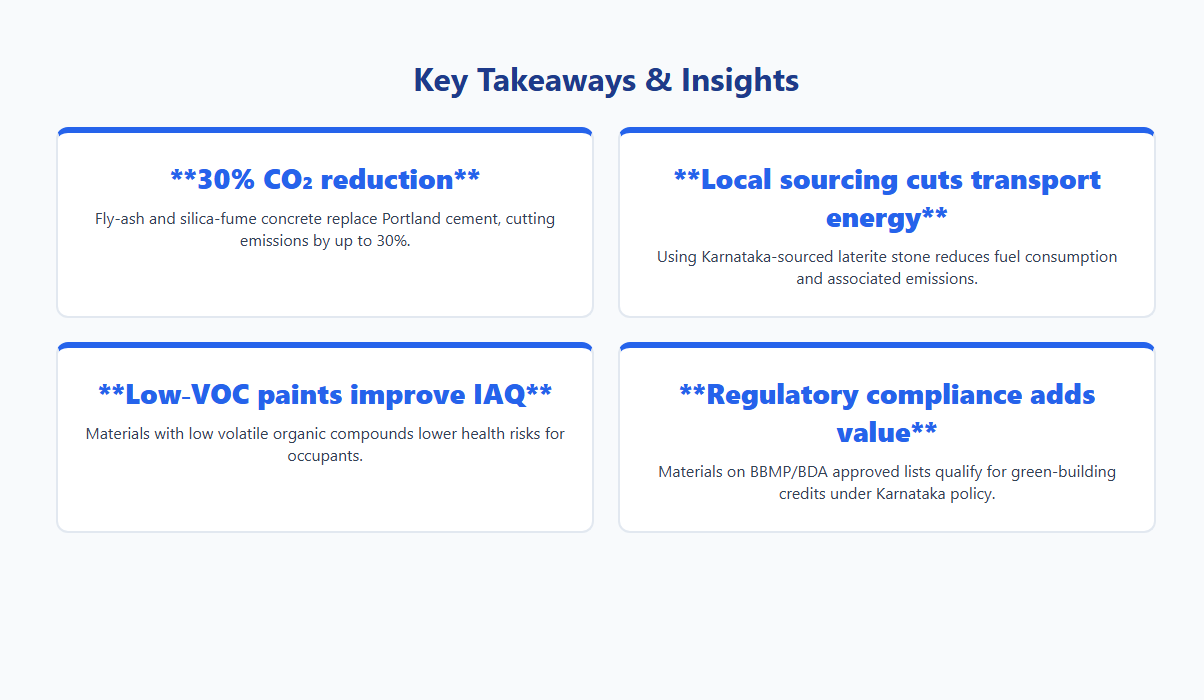
- Fly‑ash and silica‑fume concrete replace a portion of Portland cement, cutting CO₂ emissions by up to 30 %.
- Rammed‑earth walls and compressed stabilized earth blocks store thermal mass, reducing reliance on air‑conditioners.
- Green roofs and living walls provide insulation, lower urban heat‑island effects, and manage storm‑water runoff.
- Recycled steel reinforcement reduces mining demand and preserves natural habitats.
Health and indoor air quality advantages
Residents benefit from healthier indoor environments when materials emit low or no volatile organic compounds (VOCs) and regulate humidity naturally.
- Natural fibre insulation (jute, hemp) breathes, preventing mould growth.
- Low‑VOC paints and sealants eliminate harmful off‑gassing.
- Non‑toxic flooring such as polished concrete or cork avoids formaldehyde exposure.
- Passive ventilation designs paired with breathable wall systems improve air exchange without mechanical fans.
BBMP & BDA Regulations for Green Building Materials in Bangalore
Approved green material lists
The BBMP and BDA maintain a consolidated schedule of green materials that are permissible for new residential projects. This schedule is updated annually to reflect advances in sustainability and local supply chains, ensuring that builders can source products that meet both performance and environmental criteria. Only items appearing on the official list can be claimed for green‑building credits under the Karnataka Green Building Policy. Locally produced items are given priority, while imported products must meet tighter carbon‑footprint limits. For more on selecting reliable construction partners, see our guide on choosing the best home construction services in Bangalore.
- Fly‑ash based cement
- Recycled aggregate bricks
- Low‑VOC interior paints
- Thermal‑break windows
- Rammed earth walls
Mandatory certifications and clearances
Before any material is used, the developer must obtain the relevant clearances from the BBMP’s Green Building Cell and the BDA’s Building Plan Approval Division. The required documents include a material safety data sheet, a third‑party environmental impact assessment, and proof of compliance with IS standards. Failure to present these certifications can delay plan approval by up to 30 days. High‑rise residential projects also need a lifecycle assessment to confirm durability and recyclability.
- IS 14801 – Fly ash cement
- BIS certification for recycled aggregates
- GRIHA pre‑approval
- Energy Conservation Building Code (ECBC) compliance certificate
Incentives and compliance timelines
Both agencies offer financial and procedural incentives to accelerate the adoption of eco‑friendly materials in residential construction. Eligible projects can receive a reduction in development charges, expedited plan scrutiny, and access to subsidised green‑technology loans through state‑run banks. The incentive window typically spans the first two years after a project’s plan approval, after which the benefits phase out. A 4‑star GRIHA rating adds a 0.1 % property‑tax cut for five years.
- 10 % waiver on BBMP development fees
- Fast‑track BDA plan verification (within 15 days)
- Interest‑subsidised loans for certified green materials
- Additional FAR bonus of 0.2 for GRIHA‑certified homes
Locally Sourced Sustainable Materials: Options & Suppliers
Fly‑ash bricks and stabilized earth blocks
Fly‑ash bricks combine industrial by‑product ash with cement, reducing the carbon footprint of traditional fired bricks. In Bangalore’s hot‑dry climate they offer excellent thermal insulation and fire resistance, while consuming up to 70% less energy in production. Stabilized earth blocks, made from locally excavated laterite mixed with a small percentage of cement or lime, provide a low‑embodied‑energy alternative that regulates indoor humidity naturally.
- EcoBrick Solutions – Based in Whitefield, they supply fly‑ash bricks meeting IS 2185 standards, with delivery across the city.
- EarthBlock India – Operates a plant near Hoskote, offering custom‑size stabilized earth blocks and on‑site training for masons.
- GreenMasonry – Partners with local NGOs to source fly‑ash from nearby thermal power stations, ensuring traceability and low cost.
Recycled steel and aluminium framing
Recycled steel and aluminium are prized for their high strength‑to‑weight ratio, allowing slimmer columns and longer spans in residential frames. Using post‑consumer scrap reduces mining demand and cuts embodied CO₂ by up to 80% compared with virgin metal. In Bangalore’s seismic zone, these materials also provide superior ductility and resilience. For affordable building options, see our low‑cost house construction guide.
- SteelRegen Ltd. – Operates a recycling hub in Yelahanka, supplying TMT bars and structural steel with certification of recycled content.
- AluEco Fabricators – Specializes in lightweight aluminium joists and window frames, sourced from de‑commissioned aircraft parts.
- UrbanSteel Works – Offers turnkey framing packages for multistorey villas, with on‑site welding and quality control.
Bamboo, timber, and reclaimed wood sources
Bamboo grows to maturity in 3‑5 years, making it a rapidly renewable substitute for conventional timber. Treated bamboo poles are ideal for wall studs, flooring, and decorative screens. When sourced responsibly, Indian hardwoods such as teak and rosewood can be combined with reclaimed wood from demolition sites, creating a rustic aesthetic while preserving forest cover.
- BambooCraft Bangalore – Provides pre‑treated, termite‑resistant bamboo panels and offers design consultancy for bamboo‑centric homes.
- Heritage Timber – Supplies FSC‑certified teak, mahogany, and reclaimed wood sourced from old colonial structures, with custom milling services.
- EcoWood Solutions – Operates a reclaimed‑wood warehouse in Koramangala, offering reclaimed beams, planks, and furniture components for residential projects.
Performance & Cost Comparison with Conventional Materials
Structural strength and durability metrics
In Bangalore’s tropical climate, residential structures must resist high humidity, monsoon rains, and occasional seismic activity. Eco‑friendly materials such as bamboo‑reinforced concrete, fly‑ash bricks, and recycled steel frames meet or exceed Indian Standard (IS) specifications for compressive strength (≥20 MPa for walls) and tensile capacity. Durability is measured by water absorption (<10 %), carbonation resistance, and long‑term creep performance, ensuring a service life of 50‑70 years comparable to traditional fired bricks and cement.
- Compressive strength: 20‑30 MPa (eco‑concrete) vs. 15‑25 MPa (conventional).
- Flexural strength: 5‑7 MPa (recycled steel) vs. 4‑6 MPa (plain steel).
- Water absorption: <10 % (fly‑ash bricks) vs. 12‑15 % (clay bricks).
- Carbonation depth: ≤2 mm after 5 years (green mixes) vs. 3‑4 mm (standard mixes).
Life‑cycle cost analysis
While upfront prices of green materials can be 5‑15 % higher, their life‑cycle cost (LCC) is lower due to reduced maintenance, energy savings, and longer service intervals. A typical 150 sqm Bangalore home built with fly‑ash bricks shows a 12 % reduction in total LCC over 30 years, factoring in lower cooling loads, minimal plaster repairs, and the avoidance of costly demolition waste disposal.
- Initial material cost: +8 % (eco‑options).
- Maintenance savings: –20 % (reduced rot, cracks).
- Energy efficiency gain: –15 % (thermal mass).
- End‑of‑life disposal: –30 % (recyclable components).
Budgeting tips for eco‑material adoption
Homeowners can keep projects within budget by prioritising high‑impact materials and leveraging local supply chains. Early engagement with certified green‑material vendors in Bangalore often yields volume discounts. Additionally, government incentives for sustainable construction can offset up‑front costs.
- Allocate 10‑12 % of total budget for green material premium.
- Source locally produced fly‑ash bricks to cut transport fees.
- Apply for Karnataka’s “Green Building” rebate (up to 5 % of project cost).
- Phase upgrades: start with structural elements, then interior finishes.
Integrating Eco Materials into Residential Design: Practical Tips
Designing for passive cooling and daylight
Bangalore’s warm climate makes passive strategies vital. Align the house’s longer side north‑south to capture daylight while limiting direct sun. Use locally made fly‑ash bricks or rammed‑earth walls for thermal mass that stores heat by day and releases it at night. Add operable jalousie windows, ventilated roof decks, and shaded verandas to create natural cross‑ventilation. Strategic shading also reduces cooling loads, extending the life of HVAC equipment.
- Fit low‑emissivity (Low‑E) glass to admit light but reduce heat gain.
- Install bamboo sunshades or perforated metal screens to block harsh afternoon sun.
- Use reclaimed timber slats for louvers, enhancing airflow with a regional touch.
Combining traditional aesthetics with green tech
Traditional Bangalore homes showcase terracotta tiles, stone pillars, and courtyards. Modern eco‑design can preserve these forms while adding renewable tech. Pair laterite stone cladding with photovoltaic roof tiles that blend into the roofline. Choose bio‑based paints in earthy tones for low VOC emissions. These interventions respect heritage while delivering measurable energy reductions.
- Hide rain‑water harvesting tanks within classic chajja overhangs.
- Apply modular green walls made from locally grown bamboo for insulation and visual appeal.
- Use reclaimed sandstone pavers to reduce quarry impact and maintain cultural continuity.
Coordination with architects and contractors
Early collaboration ensures eco‑materials are correctly specified and installed. Involve architects who understand Bangalore’s building codes and climate. Brief contractors on proper handling of fly‑ash bricks and PV tiles to preserve performance. A clear communication protocol helps avoid delays and cost overruns.
- Hold joint design workshops to match material availability with local labor skills.
- Maintain a material‑tracking log confirming recycled content and regional sourcing.
- Set up post‑occupancy monitoring to verify energy savings and indoor comfort.
Case Studies: Successful Eco‑Friendly Homes in Bangalore
Bangalore’s rapid urbanization has spurred innovative residential projects that prioritize sustainability without sacrificing comfort. The following case studies illustrate how local builders translate eco‑friendly concepts into tangible homes, from modest neighbourhood blocks to upscale villas and multi‑family complexes.
Neighborhood project using fly‑ash bricks
The Green Enclave project in Whitefield demonstrates how fly‑ash bricks can replace conventional clay bricks without compromising strength. Local manufacturers supplied bricks made from 30 % fly‑ash, reducing the embodied carbon by roughly 20 % per unit. The development achieved a 15 % reduction in overall construction waste.
- Cost savings of 8‑10 % per square metre
- Improved thermal insulation
- Reduced water usage during curing
- Local sourcing cuts transportation emissions
- Compliance with Bangalore’s Green Building Code
Bamboo‑clad villa with rainwater harvesting
In the upscale suburb of Jayanagar, a 4,500 sq ft villa showcases a bamboo‑clad façade combined with an integrated rainwater harvesting system. The bamboo panels, sourced from certified sustainable farms in Karnataka, provide a natural aesthetic while offering a renewable alternative to steel or concrete lintels. Harvested rainwater is stored in a 10 000‑litre underground tank, supplying toilet flushing and garden irrigation, cutting municipal water demand by nearly 40 %.
- Rapid growth cycle – harvestable in 3‑5 years
- Carbon sequestration equivalent to 1 kg CO₂ per kg bamboo
- Low embodied energy compared with timber
- Natural ventilation through perforated panels
- Zero‑maintenance exterior coating
LEED‑certified apartment complex overview
The ‘EcoRise’ apartment complex in Sarjapur Road achieved LEED Gold certification by integrating multiple eco‑friendly strategies across its 12‑unit residential towers. High‑performance insulated concrete forms (ICFs) form the structural core, while solar photovoltaic panels generate 30 % of the building’s electricity. Smart lighting, low‑flow fixtures, and a community composting hub further reduce operational carbon footprints.
- Energy‑Star rated appliances in every unit
- Grey‑water recycling for landscape irrigation
- Triple‑glazed windows with low‑E coating
- Rooftop garden reducing urban heat island effect
- Resident education program on waste segregation
Maintenance, Longevity, and Future‑Proofing Your Green Home
Routine care for recycled materials
Recycled aggregates, reclaimed timber, and fly‑ash bricks behave like conventional products but require a tailored maintenance plan that respects Bangalore’s monsoon climate and high humidity. Regular visual inspections after each rainy season help identify early signs of moisture ingress, efflorescence, or surface wear. Cleaning should use mild, pH‑balanced detergents and soft brushes to avoid damaging protective coatings on recycled concrete surfaces.
- Seal joints and seams every 12‑18 months with low‑VOC, water‑based sealants to prevent water penetration.
- Apply breathable, anti‑mold paints on reclaimed wood to guard against fungal growth without trapping moisture.
- Schedule a professional structural audit every five years to verify that load‑bearing recycled elements retain their design strength.
Upgrading to newer sustainable technologies
As Bangalore’s green building ecosystem evolves, homeowners can future‑proof their residences by integrating emerging technologies without extensive demolition. Modular wall panels made from hemp‑lime, solar‑responsive glazing, and smart ventilation systems can be retrofitted onto existing frames, enhancing energy efficiency while preserving the original eco‑friendly intent.
- Replace standard LED fixtures with solar‑powered, dimmable LEDs that sync with daylight sensors.
- Install rain‑water harvesting modules that connect directly to recycled‑plastic storage tanks already embedded in the foundation.
- Upgrade insulation with bio‑based spray foams that expand to fill gaps, improving thermal performance without adding bulk.
Resale value and market perception
Eco‑conscious buyers in Bangalore increasingly associate sustainable construction with long‑term cost savings and a healthier indoor environment. Proper maintenance records, certifications such as GRIHA or LEED, and documented upgrades can significantly boost a property’s market appeal.
- Homes with verified recycled‑material usage often command a 5‑10 % premium over conventional counterparts.
- Transparent maintenance logs reassure buyers of the building’s durability and reduced future repair costs.
- Positive community perception of green neighborhoods can accelerate sales cycles and attract higher‑quality tenants.