


When you dive into the bustling construction scene of India’s tech hub, one phrase you’ll hear repeatedly is Understanding contractor payment structures Bangalore. The city’s rapid skyline growth has spurred a variety of payment models, from hourly rates for skilled labor to fixed-price contracts for complete turn‑key projects. Most contractors align their fees with the Revised Payment Terms under the Karnataka Contract Labour (Regulation & Welfare) Act, ensuring compliance with statutory deductions like GST and professional tax. Knowing whether a contractor prefers milestone‑based payouts or a simple retainer can save you both time and money.
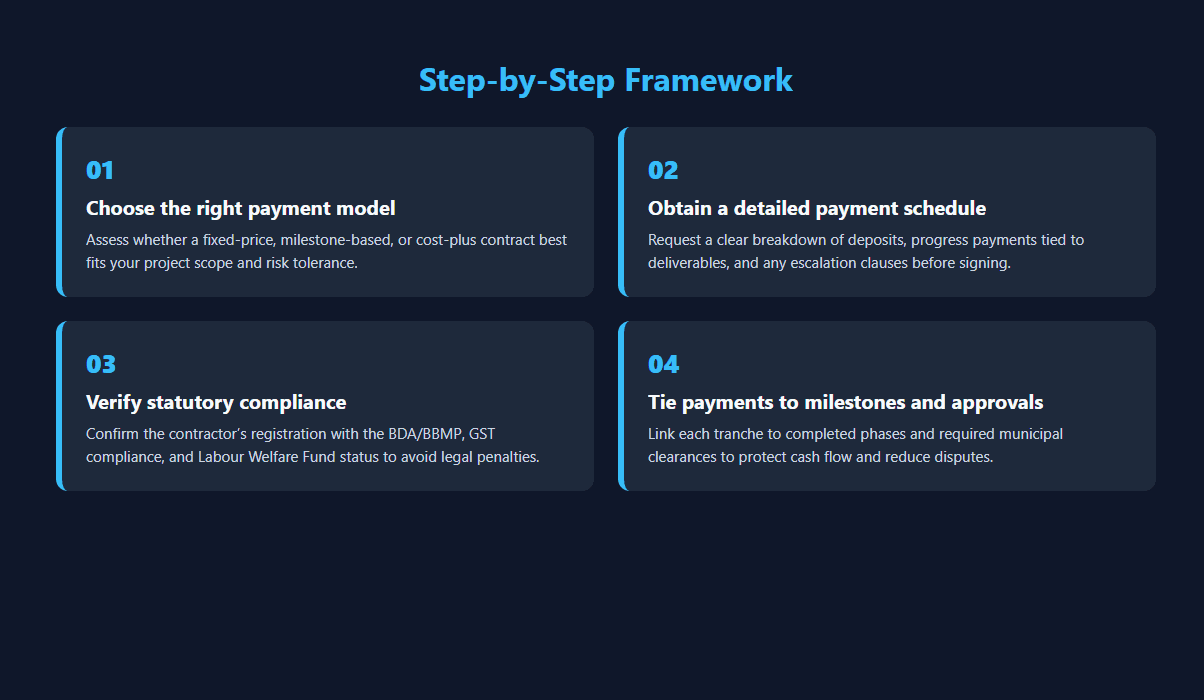
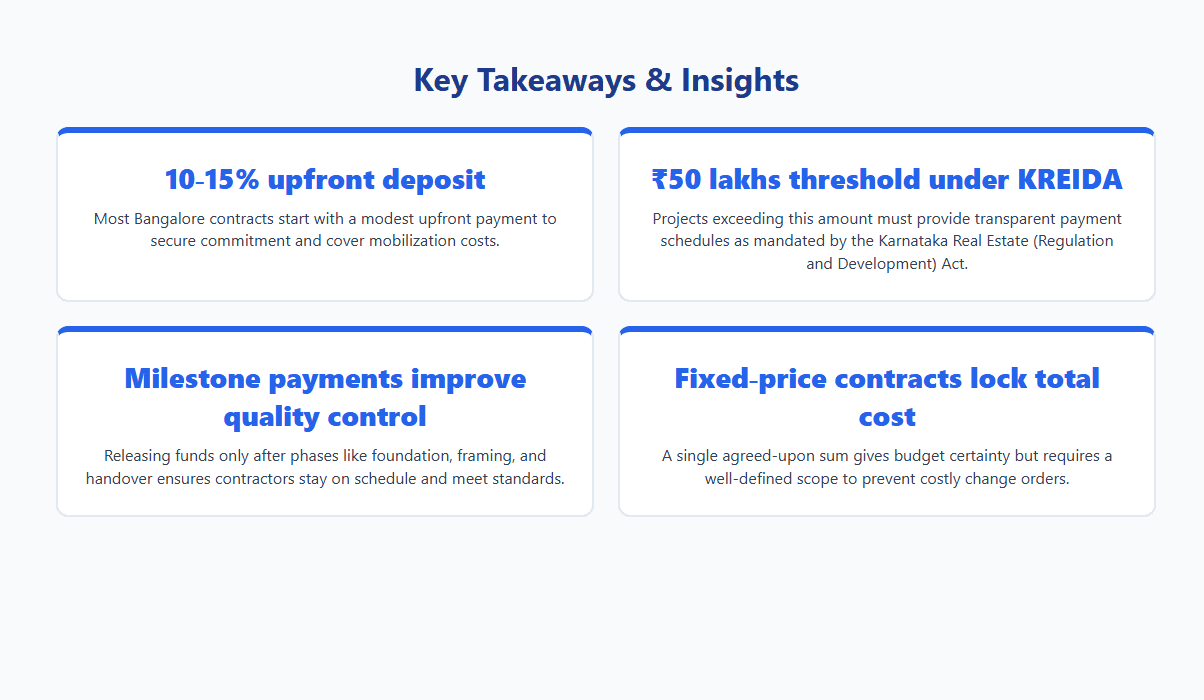
In practice, Bangalore firms often adopt a hybrid approach: a modest upfront deposit (typically 10‑15 % of the total contract) followed by progress payments tied to clearly defined deliverables such as foundation completion, structural framing, and final handover. This method aligns cash flow with project milestones and reduces the risk of payment disputes. Additionally, many contractors incorporate escalation clauses to account for fluctuating material costs, especially for steel and cement. By requesting a detailed payment schedule and verifying the contractor’s registration with the Bangalore Municipal Corporation, clients can ensure transparency and protect their investment throughout the construction lifecycle. Stay informed, and your projects will thrive successfully.
Common Contractor Payment Models in Bangalore
Overview of prevalent payment types
Homeowners in Bangalore encounter three dominant payment structures from expert building contractors. Each model balances risk, cash‑flow timing, and project transparency, influencing how budgets are managed from start‑up to hand‑over.
- Fixed‑price contract: A single, agreed‑upon sum covers the entire scope, ideal for well‑defined projects with limited design changes.
- Milestone‑based payments: Funds are released after the completion of predefined phases such as foundation, roofing, and finishing, providing checkpoints for quality assurance.
- Cost‑plus arrangement: The homeowner reimburses actual expenses plus a predetermined fee or percentage, offering flexibility for evolving designs but requiring rigorous documentation.
Why payment structure matters for homeowners
The chosen payment model directly impacts financial risk, project control, and dispute resolution. Understanding these effects helps homeowners protect their investment and maintain a realistic cash‑flow schedule.
- Fixed‑price reduces surprise costs but may encourage contractors to cut corners to protect margins.
- Milestone payments align contractor incentives with progress, allowing owners to verify quality before releasing funds.
- Cost‑plus contracts provide design freedom but demand detailed invoicing and regular audits to avoid overruns.
- Clear payment terms simplify legal recourse if work is delayed or substandard, as the contract serves as an objective reference point.
Regulatory considerations in Bangalore
Local statutes and municipal guidelines shape how contracts must be drafted and executed. Compliance not only safeguards the project but also prevents penalties from authorities.
- The Karnataka Real Estate (Regulation and Development) Act mandates transparent payment schedules for residential works exceeding ₹50 lakhs.
- Contractors must register with the Bangalore Development Authority (BDA) and provide a GST‑compliant invoice for every payment tranche.
- Builders are required to obtain a Completion Certificate from the BBMP; payment releases are often tied to interim approvals such as structural and fire safety clearances.
- Homeowners should verify that the contractor holds a valid Labour Welfare Fund registration, ensuring workers’ rights and reducing the risk of labor‑related legal disputes.
Fixed-Price Contracts: Benefits and Risks
How a fixed total price is determined
In Bangalore’s bustling construction market, a fixed-price contract is typically derived from a detailed scope of work, material take‑offs, and labor estimates. Contractors break the project down into measurable units, apply prevailing market rates, and add a contingency margin to cover unforeseen site conditions. The final figure is then negotiated with the client, often after a series of site visits and design reviews to ensure every deliverable is accounted for.
- Comprehensive Bill of Quantities (BoQ) prepared by a quantity surveyor.
- Unit rates sourced from recent local projects and supplier quotations.
- Contingency allowance (usually 5‑10%) for minor variations.
- Client‑approved scope changes incorporated before final sign‑off.
Advantages for budget certainty
Fixed-price contracts provide a clear financial roadmap, which is especially valuable for developers managing multiple projects in Bangalore’s high‑growth zones. Since the total cost is locked in early, cash‑flow planning becomes straightforward, and stakeholders can avoid surprise overruns that strain relationships and delay timelines.
- Predictable total expenditure eliminates hidden costs.
- Facilitates easier financing arrangements with banks and investors.
- Reduces administrative burden of frequent cost revisions.
- Enhances client confidence and supports competitive bidding.
Potential pitfalls and change order handling
While the certainty of a fixed price is appealing, it can mask risks if the original scope is poorly defined. Unforeseen site conditions, regulatory changes, or client‑initiated design tweaks often trigger change orders, which can erode profit margins and lead to disputes. Effective change‑order management is therefore critical.
- Establish a clear change‑order clause in the contract.
- Document all scope modifications with revised cost estimates.
- Agree on a pre‑defined escalation formula for material price fluctuations.
- Maintain open communication to resolve disputes promptly.
Cost-Plus and Unit Rate Agreements Explained
Understanding cost-plus mechanics
In a cost‑plus contract the contractor bills the client for the actual cost of labor, materials, and equipment, then adds a pre‑agreed fee or percentage for profit. This model is popular for projects where scope is uncertain, such as renovations in heritage areas of Bangalore or fast‑track infrastructure upgrades. It encourages the contractor to use quality inputs because their profit is tied to the total expenditure, not to cutting corners.
- Direct material receipts are recorded daily.
- Labor hours are logged via biometric or digital timesheets.
- Overhead allocation follows a fixed percentage agreed at contract signing.
- Profit margin is typically 8‑12 % of verified costs.
- Regular cost reconciliations are scheduled bi‑weekly.
When unit rates are preferred
Unit‑rate contracts assign a fixed price to each measurable unit of work—e.g., per square meter of tiling or per linear foot of piping. This approach suits large‑scale, repetitive tasks common in Bangalore’s residential complexes and commercial towers, where the quantity can be accurately forecasted. It provides the client with budget certainty and simplifies progress billing.
- Clear measurement standards are defined in the tender documents.
- Scope changes trigger re‑evaluation of unit prices.
- Payments are released upon verification of completed units.
- Risk of cost overruns shifts largely to the contractor.
- Unit rates are benchmarked against market indices for fairness.
Transparency and documentation requirements
Both payment structures demand rigorous documentation to maintain trust and avoid disputes. In Bangalore’s regulated environment, authorities often audit contracts for compliance with the Real Estate (Regulation and Development) Act and GST norms. Contractors must retain original invoices, delivery challans, and signed work‑completion certificates.
- Maintain a digital ledger of all cost entries.
- Submit monthly audit reports to the client’s project manager.
- Use third‑party quantity surveyors for independent verification.
- Archive all correspondence for a minimum of five years.
- Ensure GST invoices reflect the exact cost‑plus or unit‑rate breakdown.
Milestone and Progress Billing Structures
Linking payments to construction phases
In Bangalore’s fast‑moving real‑estate market, contractors and owners increasingly rely on milestone‑based billing to align cash outflows with tangible progress. Each payment is triggered only when a clearly defined phase—such as foundation work, structural framing, or interior fit‑out—is completed and verified by a site engineer or an independent consultant. This approach reduces the risk of over‑payment, provides a transparent audit trail, and encourages contractors to adhere to the project schedule.
- Foundation and sub‑structure: 20‑25% of total contract value.
- Superstructure erection: 30‑35% after column and beam completion.
- Roofing, waterproofing, and external works: 15‑20% upon final external inspection.
- Finishing and handover: remaining 20‑25% after snag list clearance.
Typical milestone definitions
Milestones are not arbitrary; they are derived from the building code, local municipal approvals, and the contractor’s own execution plan. In Bangalore, common milestones include:
- Site mobilization – delivery of equipment, temporary utilities, and safety setup.
- Excavation and foundation – completion of earthwork, piling, and concrete footings.
- Structural framework – erection of load‑bearing elements and slab casting.
- MEP rough‑in – installation of ductwork, plumbing, and electrical conduits before wall closure.
- Final fit‑out – painting, flooring, fixtures, and client‑specific finishes.
Managing cash flow for both parties
Effective cash‑flow management hinges on synchronizing invoicing with milestone verification while preserving sufficient liquidity for ongoing work. Contractors benefit from predictable receivables, whereas owners avoid tying up capital in unfinished work.
- Use escrow accounts or bank guarantees to secure payments until milestones are signed off.
- Incorporate a retention clause (typically 5‑10%) released after the defect liability period.
- Schedule interim payments on a bi‑weekly or monthly basis to smooth out cash‑flow spikes.
- Maintain a shared digital dashboard that logs progress photos, inspection reports, and payment status in real time.
Time & Material Contracts: When They Make Sense
Pricing based on labor and material rates
In Bangalore’s fast‑moving construction and IT services markets, Time & Material (T&M) contracts tie payment directly to the actual hours worked and the cost of consumables. Rates are typically quoted per engineer, technician or tradesperson, with a separate markup for materials such as steel, concrete or software licences. According to a 2023 industry survey, average hourly rates for senior developers range from INR 1,500 to 2,500, while skilled carpenters are billed at INR 600‑900. Material mark‑ups hover around 10‑15 % of the vendor price, providing a transparent cost structure that both parties can audit.
- Labor rate = base salary + overhead + profit margin.
- Material rate = supplier cost + handling + markup.
- Rates are reviewed quarterly to reflect market inflation.
Ideal scenarios for T&M contracts
These contracts shine when project scope is uncertain or likely to evolve. Start‑up product launches, agile software sprints, and renovation projects with hidden structural issues benefit from the flexibility T&M offers. In Bangalore’s tech corridor, rapid pivots are common; a T&M model lets clients add features without renegotiating a fixed‑price amendment. Similarly, infrastructure upgrades in heritage zones often uncover unforeseen constraints, making a fixed‑price approach risky.
- Projects with evolving requirements.
- Short‑term engagements where speed outweighs cost certainty.
- Clients who maintain strong oversight and can approve work incrementally.
Controls to prevent cost overruns
Without disciplined governance, T&M can lead to budget creep. Effective controls include detailed daily logs, pre‑approved change‑order thresholds, and regular variance analysis against a baseline budget. Many Bangalore firms embed a “cap‑on‑expenditure” clause that triggers a review once spending reaches 80 % of the estimated ceiling. Independent audits and transparent invoicing further safeguard against hidden costs.
- Require weekly time‑sheet approvals.
- Set material purchase limits per line item.
- Implement a joint steering committee for scope changes.
Hybrid Payment Models and Custom Arrangements
Combining fixed and variable components
In Bangalore’s fast‑moving construction and IT services sectors, many firms blend a baseline fixed fee with performance‑linked variables. The fixed portion guarantees baseline cash flow for contractors, covering core labor, equipment, and compliance costs. Variable components—often tied to milestones, quality metrics, or early‑completion bonuses—align incentives and reward efficiency. This dual structure mitigates risk for both parties: owners avoid overpaying for delays, while contractors benefit from upside potential when they exceed expectations.
- Base fee covers labor, material markup, and statutory contributions.
- Milestone bonuses trigger on design approval, prototype delivery, or phase handover.
- Quality incentives linked to defect‑free handover or client satisfaction scores.
- Early‑completion premiums encourage accelerated schedules.
- Penalty clauses for missed deadlines balance the upside.
Tailoring contracts to project complexity
Projects in Bangalore range from single‑storey residential builds to multi‑billion‑rupee smart‑city initiatives. A one‑size‑fits‑all payment schedule rarely works. For low‑complexity tasks, a simple fixed‑price contract may suffice. As technical depth, regulatory scrutiny, or stakeholder count grows, hybrid models become essential. Contractors can embed tiered variable rates that reflect design changes, technology integration, or unforeseen site conditions, ensuring the contract remains flexible without compromising financial predictability.
- Simple fixes for straightforward renovations.
- Tiered variables for medium‑scale commercial projects.
- Multi‑layered incentives for large infrastructure or software development.
- Adjustment clauses for regulatory or zoning changes.
- Scope‑flexibility clauses for iterative design processes.
Negotiation tips for hybrid deals
Successful hybrid agreements hinge on clear communication and data‑driven benchmarks. Begin by mapping out all deliverables and assigning realistic monetary values to each milestone. Use historical performance data from similar Bangalore projects to justify variable rates. Ensure transparency in how bonuses and penalties are calculated, and embed dispute‑resolution mechanisms to handle ambiguities. Finally, keep the contract language concise—avoid jargon that could be misinterpreted during execution.
- Define measurable milestones before signing.
- Reference local market rates and past project outcomes.
- Document calculation formulas for bonuses and penalties.
- Include a clear escalation path for disputes.
- Review and adjust terms quarterly for long‑duration contracts.
Choosing the Right Payment Structure for Your Project
Assessing project size and risk tolerance
In Bangalore’s fast‑moving construction market, the scale of a project directly influences the most suitable payment model. Small residential remodels often thrive under a fixed‑price arrangement because the scope is well‑defined and the contractor can accurately estimate material and labor costs. Larger commercial builds, however, carry greater uncertainty—design changes, regulatory approvals, and fluctuating material prices—making a cost‑plus or milestone‑based schedule more practical. Evaluating your own risk appetite is essential: if you prefer price certainty, lean toward fixed‑price; if you can absorb variability for greater flexibility, consider a hybrid model that blends fixed milestones with cost‑plus elements.
- Project budget range (₹ 5 Lakh – ₹ 10 Crore)
- Complexity of design and likelihood of revisions
- Contractor’s track record with similar‑sized jobs
- Your organization’s capacity to manage cash‑flow fluctuations
Aligning payment model with financing plans
Financing structures in Bangalore—whether bank loans, internal funds, or investor capital—must sync with the contractor’s payment schedule to avoid liquidity gaps. A milestone‑based payment plan aligns well with phased disbursements from banks, as each draw can be tied to a completed stage (foundation, superstructure, finishing). Conversely, a lump‑sum upfront payment may be feasible for projects funded entirely from equity, reducing administrative overhead. Ensure that the chosen model does not force you to breach loan covenants or incur unnecessary interest costs.
- Map loan draw‑down dates to construction milestones
- Include buffer periods for approvals and inspections
- Negotiate retention percentages that match cash‑flow forecasts
- Confirm that any escalation clauses are compatible with financing terms
Checklist for final contract selection
Before signing, run a comprehensive checklist to verify that the payment structure supports both project goals and financial health. This ensures transparency, reduces disputes, and safeguards against cost overruns.
- Clear definition of deliverables for each payment milestone
- Explicit clauses for change orders and price adjustments
- Retention and warranty terms that protect client interests
- Dispute resolution mechanism and timeline for payment releases
- Compliance with local Bangalore regulations and GST implications